
The Jedi Code
A contemplative framework, not a rigid command.
The Jedi Code is the foundation of our principles: a contemplative framework for moving toward peace, knowledge, serenity, harmony, and relationship with the Force.
THERE IS NO EMOTION; THERE IS PEACE.Explore
Peace does not require the absence or suppression of emotion. Emotions are part of human experience and can provide important information about needs, values, relationships, and danger. Fear, anger, grief, desire, and excitement can influence perception and judgment, but a Jedi works to understand those emotions rather than allowing them to automatically determine action.
Through reflection, mindfulness, meditation, and experience, the Jedi learns to stand beside emotion, consider what it is communicating, and choose a response with clarity, compassion, and responsibility. Peace is not the absence of feeling; it is the ability to remain intentional within it.
THERE IS NO IGNORANCE; THERE IS KNOWLEDGE.Explore
A Jedi remains a student. Knowledge requires observation, evidence, reason, experience, reflection, and the humility to distinguish what is known from what is believed, assumed, interpreted, or merely possible.
The Jedi questions their own conclusions as readily as the conclusions of others and remains willing to revise an understanding when better evidence becomes available. Epistemic integrity includes knowing when to say "I don't know." Curiosity and skepticism can coexist, allowing the Jedi to investigate the Force, the world, and unusual experiences without confusing possibility with proof.
THERE IS NO PASSION; THERE IS SERENITY.Explore
The Code does not require a passionless life. Love, care, creativity, purpose, and enthusiasm can all motivate meaningful action. Difficulty arises when desire becomes possessive, compulsive, or so attached to an outcome that judgment, autonomy, or compassion are lost.
A Jedi practices non-attachment by caring without attempting to own, control, or force an outcome. Serenity is the ability to act with purpose while remaining capable of letting go, changing direction, and respecting the freedom and needs of others.
THERE IS NO CHAOS; THERE IS HARMONY.Explore
Harmony does not mean that disorder, conflict, or uncertainty cease to exist. Reality contains differences, opposing forces, change, and relationships that may not always be easy to reconcile.
A Jedi seeks to understand those relationships and to participate in ways that reduce unnecessary harm and create conditions for balance, cooperation, and growth. Harmony can be observed, restored, or created through wise participation. It does not require pretending that chaos is absent.
THERE IS NO DEATH; THERE IS THE FORCE.Explore
Death reminds the Jedi that individual life is impermanent and that attachment to permanence can become a source of fear and suffering. The Force provides a framework for understanding the self as part of relationships larger than the individual: living systems, nature, community, history, matter, energy, influence, memory, and whatever dimensions of existence remain unknown.
Jedi may hold different religious or spiritual beliefs concerning death, rebirth, consciousness, or an afterlife; those interpretations should not be presented as established fact. The shared teaching is to meet impermanence with humility and to recognize that our participation in existence extends beyond what we can possess or control.
Beyond the Code
The Jedi Principles
The Code provides the philosophical foundation, the Three Pillars describe the core approach to Jedi practice, and Choose C.O.U.R.A.G.E. provides an ethical framework for applying them through choice and action.
The Three PillarsExplore
These core ideals highlight our approach to Jediism and self-mastery.
KnowledgeExplore
There is no ignorance; there is knowledge. Knowledge is where the Jedi begin and their first pillar. Before you can meaningfully discipline yourself or develop a relationship with the Force, you need to understand what you're dealing with: yourself, others, the world, your emotions, your limitations, and the principles you're trying to follow.
Knowledge also protects against superstition and assumption. Knowledge is the pursuit of wisdom, understanding, and insight into the Force and the universe. For Jedi, it involves a good education, continued individual study, learning about the ways of the Force, and acquiring both practical and philosophical understanding.
Knowledge empowers Jedi to make informed decisions, solve problems, and enhance their abilities. It is through knowledge that Jedi gain the clarity needed to act with wisdom and uphold their values in the face of challenges.
Self-DisciplineExplore
Self-discipline is the second pillar of Jedi training. There is no emotion; there is peace and there is no passion; there is serenity.
A person can understand anger without being able to control how they respond to it. They can understand attachment without being able to release it. They can understand fear while still being ruled by it. Self-discipline turns knowledge into practice.
Self-discipline is the practice of controlling one's emotions, actions, and desires to maintain balance and focus. For Jedi, self-discipline is essential in resisting the temptations of the dark side and ensuring that their actions align with their principles.
It involves rigorous training, mental fortitude, and a commitment to personal growth. Self-discipline enables Jedi to act with integrity, remain calm under pressure, and uphold their commitment to peace and justice.
The ForceExplore
The third and final pillar is The Force. There is no chaos; there is harmony, and there is no death; there is The Force.
The Force is not necessarily something a Jedi simply learns or controls, but the larger reality with which the Jedi develops a relationship.
Knowledge teaches the Jedi what they are observing. Self-Discipline teaches the Jedi how to participate without being ruled by themselves. The Force represents the relationships within and beyond the self: how things interconnect, interact, influence one another, and participate in the balance of our shared existence.
No individual or subjective definition or interpretation of the Force should override our broader understanding of how it manifests, how we experience it, and how we relate to it without sufficient substantiated evidence.
Different scientific, philosophical, religious, spiritual, and cultural perspectives may be used to explore the Force without requiring any one interpretation to be accepted as its complete explanation.
The Force is not merely something the Jedi possesses. It is something of which everything is a part.
The Light (Ashla)Explore
The Light Side of the Force, also known as Ashla in Star Wars lore, represents tendencies toward harmony, compassion, wisdom, selflessness, knowledge, healing, justice, responsibility, and constructive participation within the Force.
A Jedi who aligns with the Light seeks to support life, growth, understanding, peace, and the greater good while recognizing the relationships and consequences created through their choices.
The Light does not require perfection or the absence of difficult emotions. Rather, the Jedi seeks through knowledge and self-discipline to prevent fear, anger, attachment, desire, or ego from unconsciously governing their actions.
A Jedi understands their ability both to influence and be influenced through the Force and seeks to participate within those relationships with wisdom, compassion, integrity, and intention.
The Dark (Bogan)Explore
The Dark Side of the Force, also known as Bogan in Star Wars lore, represents tendencies toward destructive imbalance through uncontrolled fear, anger, hatred, greed, jealousy, deception, domination, destructive attachment, and the pursuit of power at the expense of others or the greater whole.
The Dark is not simply the existence of difficult emotions or self-interest. Fear, anger, desire, and attachment are parts of human experience and may provide useful information. Darkness develops when these begin to govern perception and action without sufficient knowledge, self-awareness, or discipline.
The Dark may therefore manifest through manipulation, exploitation, unnecessary aggression, obsession, domination, or disregard for the consequences one's choices have upon others.
Understanding the Dark is necessary to Jedi practice. A Jedi must remain capable of recognizing destructive tendencies not only in others, but within themselves. Understanding the Dark does not require serving it. Awareness allows the Jedi to choose differently.
The Gray (Bendu)Explore
Between clear expressions of Light and Dark are circumstances of uncertainty, competing interests, and apparent neutrality.
A Jedi may sometimes need to withdraw, observe, wait, or refrain from action. Neutrality itself is not necessarily wrong. However, neutrality should not become an excuse for indifference when circumstances reasonably call for action.
In Star Wars lore, Bendu represents a claimed position between the Light and Dark. This provides a useful philosophical question for the Jedi: whether remaining outside a conflict represents balance, wisdom, avoidance, or indifference depends upon the circumstances and consequences.
For the Jedi, balance does not mean assigning Light and Dark equal ethical value. The Jedi seeks to understand both, recognize their capacity for both, and intentionally move toward the Light.
The Jedi understands Light and Dark, accepts their capacity for both, and chooses how to participate.
Ethical Framework — Choose C.O.U.R.A.G.E. Explore
A Jedi seeks knowledge, practices self-discipline, develops a relationship with the Force, and has the courage to choose with Compassion, Objectivity, Utility, Respect, Accountability, Growth, and Ethical Integrity.
8 Points of Ethics
The Jedi Code provides the philosophical foundation of the path, while the Three Pillars describe the means through which a Jedi develops understanding, discipline, and relationship with the Force. Ethics address the next question: how should that understanding be applied through choice and action?
The following framework is organized around “Choose C.O.U.R.A.G.E.” Choice is the point at which knowledge, self-discipline, circumstance, and intention become action. A Jedi therefore seeks to choose with Compassion, Objectivity, Utility, Respect, Accountability, Growth, and Ethical Integrity (C.O.U.R.A.G.E.). These principles support one another and should be considered together rather than treated as a rigid hierarchy.
These principles are not intended to provide an automatic answer to every situation. Circumstances differ, information may be incomplete, values may conflict, and even well-intended choices may produce unexpected consequences. The purpose of the framework is to provide a consistent set of questions through which a Jedi can examine a decision, act intentionally, remain accountable for the result, and continue learning from experience.
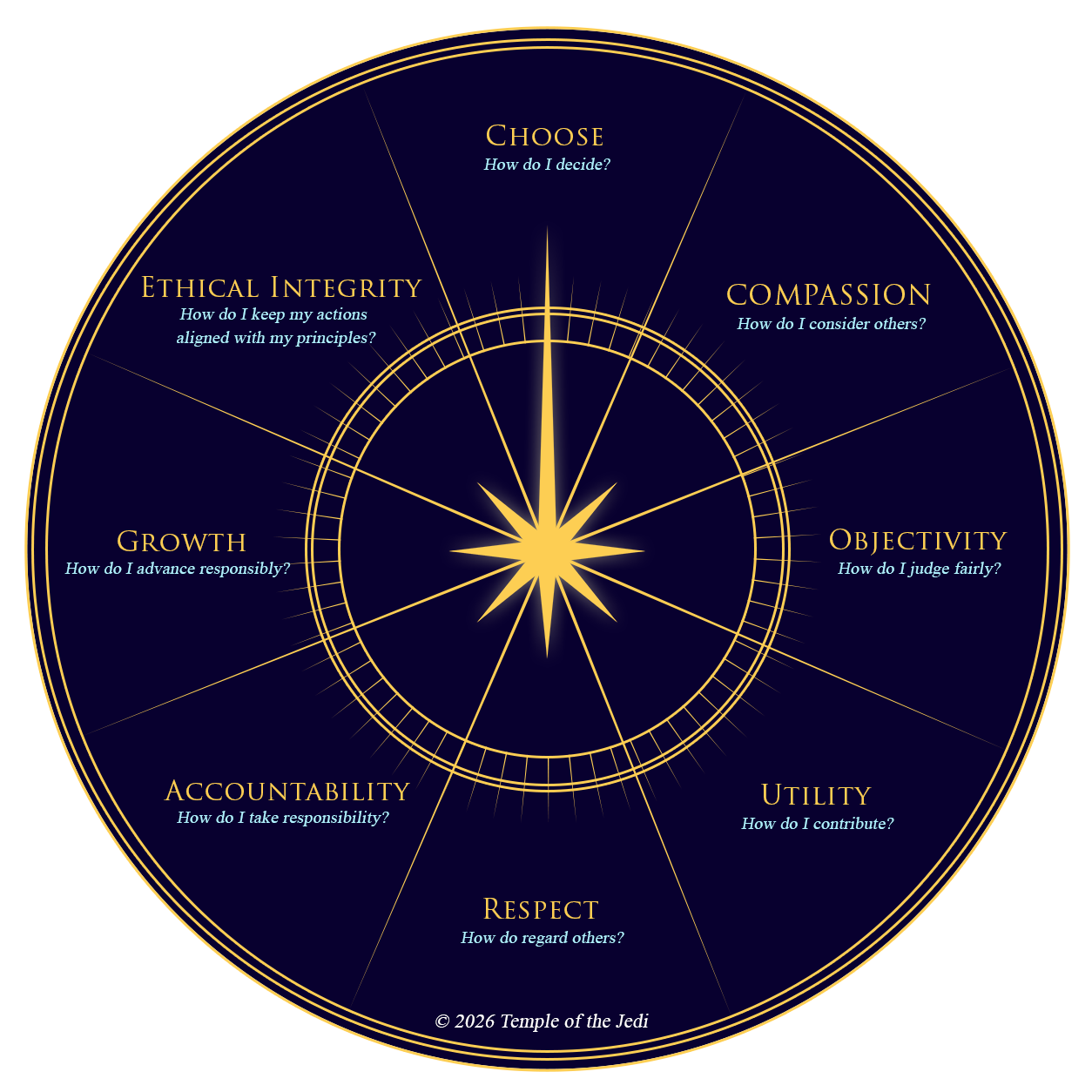
Choose Explore
How do I decide?
Choice is the point at which understanding becomes action. A Jedi considers what can reasonably be known, what remains uncertain, what influences the decision, the available alternatives, relevant risks, and the reasonably foreseeable consequences of both action and inaction. A Jedi considers their own motivations, assumptions, biases, fears, and attachments as influences upon choice. Emotions may provide useful information without automatically determining action, and attachments should be recognized when they distort judgment, create unhealthy dependence, or make adaptation and release difficult. A Jedi avoids unnecessary recklessness and seeks to choose intentionally where meaningful choice exists.
Compassion Explore
How do I consider others?
Compassion requires a willingness to loosen attachment to one's own perspective and move toward understanding the perspective and experience of another. A Jedi considers the experiences, dignity, needs, circumstances, and wellbeing of others when deciding how to act. Compassion remains important even in disagreement, but does not require abandoning boundaries, evidence, accountability, fairness, or justice. It should strengthen wise service and respect rather than replace judgment.
Objectivity Explore
How do I judge fairly?
A Jedi seeks relevant information before reaching important conclusions and works to recognize the influence of personal, emotional, social, and cultural bias. Objectivity requires considering competing perspectives and interpretations rather than seeking only information that confirms an existing belief. When personal involvement significantly compromises judgment, a Jedi seeks additional perspectives or withdraws from the decision where appropriate. Objectivity is not perfect neutrality; it is the continuing discipline of improving judgment through self-awareness and examination.
Utility Explore
How do I contribute?
A Jedi seeks to contribute in ways that provide meaningful benefit rather than merely appearing helpful. Utility concerns the usefulness of actions and contributions, not the worth of people. For a Jedi, utility is the practical measure of service: not simply whether an action was intended to help, but whether it provides meaningful benefit while respecting those affected. Contribution may involve individuals, communities, animals, nature, knowledge, society, or other relationships where meaningful benefit can reasonably be provided. Utility considers whether action or inaction is likely to improve a situation, whether assistance respects consent and reasonable authority, and whether the response is proportionate to the need. Good intentions alone do not establish usefulness. A Jedi considers foreseeable consequences, unintended harm, dependence, and whether prevention, communication, cooperation, or another approach could accomplish the same purpose more responsibly.
Respect Explore
How do I regard others?
A Jedi recognizes the dignity, autonomy, boundaries, and reasonable choices of others. Respect does not require agreement, obedience, or approval, and another person may be challenged without denying their worth. A Jedi also respects beneficial structures of order while recognizing that laws, rules, customs, institutions, and authority are not inherently just merely because they exist. Respect therefore includes the willingness to responsibly challenge harmful conduct or systems while remaining aware of how one's own words and actions affect others; intention and impact are not always the same.
Accountability Explore
How do I take responsibility?
A Jedi is accountable for their actions, intentions, and reasonably foreseeable consequences. Accountability requires the humility to acknowledge mistakes, learn from them, correct what reasonably can be corrected, change behaviour when necessary, and make reasonable efforts to repair harm caused. Good intentions, rank, orders, rules, tradition, or authority do not remove personal accountability. A Jedi also considers the difference between intended and actual effects rather than using intention alone to judge their own conduct.
Growth Explore
How do I advance responsibly?
A Jedi remains a student and continues developing knowledge, skill, resilience, judgment, and practical capability in ways that support constructive and responsible action. Development alone is not necessarily growth. Growth occurs when development meaningfully improves understanding, capability, wellbeing, judgment, relationships, or the ability to contribute responsibly. Accumulating knowledge, skill, experience, status, or achievement without improving how those things are understood or applied should not be mistaken for growth.
Growth should be pursued according to the individual’s abilities, circumstances, responsibilities, access to resources, and reasonable limits rather than against a single standard of performance or opportunity. Equity recognizes that people may require different forms of support, accommodation, time, instruction, or pathways in order to have meaningful opportunities for growth.
Growth also requires respecting the limits of others. A Jedi should not assume that another person can, should, or must develop at the same pace, in the same way, or toward the same abilities as themselves. Teaching, mentorship, leadership, and service should support growth without creating unnecessary pressure, dependency, comparison, or expectations beyond what can reasonably be sustained.
Responsible growth includes maintaining oneself through appropriate self-care, rest, recovery, reflection, boundaries, and support, because the ability to learn, serve, reason, and act depends partly upon sustaining the self. It also includes fortitude: perseverance when continuing remains worthwhile, balanced by the wisdom to adapt, rest, change approaches, seek assistance, or release.
Physical, scholarly, contemplative, communicative, creative, technical, defensive, or other useful arts may contribute to growth according to the individual’s abilities, interests, needs, and circumstances. The goal is not development for its own sake or conformity to an arbitrary ideal, but development that meaningfully improves each person’s capacity to learn, contribute, relate, and act well.
Ethical Integrity Explore
How do I keep my actions aligned with my principles?
A Jedi seeks consistency between their principles, words, knowledge, and actions, whether or not anyone else is watching. Integrity requires honesty about what is known, what is uncertain, and what is not known, and rejects knowingly distorting or concealing relevant information merely to protect belief, reputation, authority, institution, or personal interest. Loyalty is ultimately to the principles represented by the Jedi Code rather than to an unexamined interpretation of them; integrity therefore also requires reconsidering an interpretation when better-supported understanding reveals a contradiction or error.
The Code in practice
Peace. Knowledge. Serenity. Harmony. Relationship.
The Code becomes useful when it changes how a Jedi observes, chooses, learns, relates, and acts—not when it is repeated without reflection.